




Suprathermal Ions
Remnants of past energetic events
Suprathermal ions are particles with energies above the thermal solar wind but below fully accelerated cosmic rays. These remnant populations exhibit a universal spectral index of 2.5 that remains invariant across nine different elements and two full solar cycles, revealing a fundamental constraint on particle acceleration in the heliosphere.
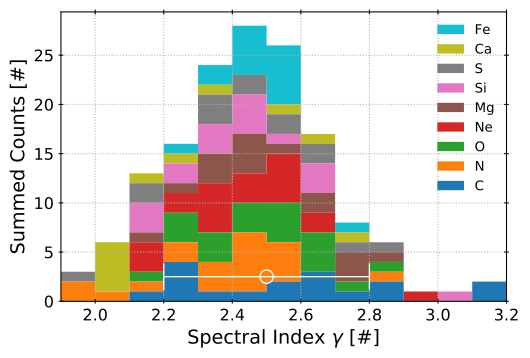
Two decades of measurements converge on a single spectral slope of 2.5
Related Figures
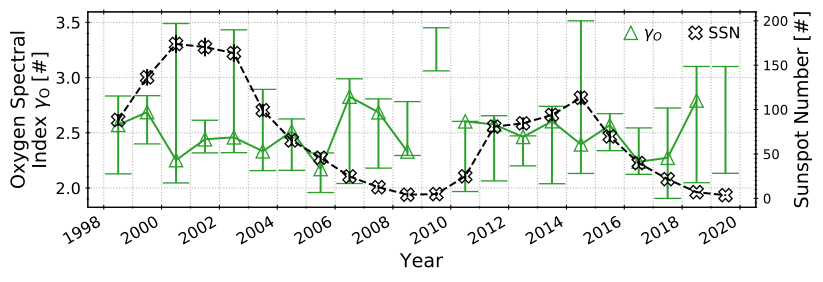
Spectral slope holds steady as sunspot activity rises and falls
Over more than two decades, the oxygen spectral slope fluctuates around a value of roughly 2.5 without tracking the dramatic swings in sunspot activity.
Demonstrates independence from solar activity
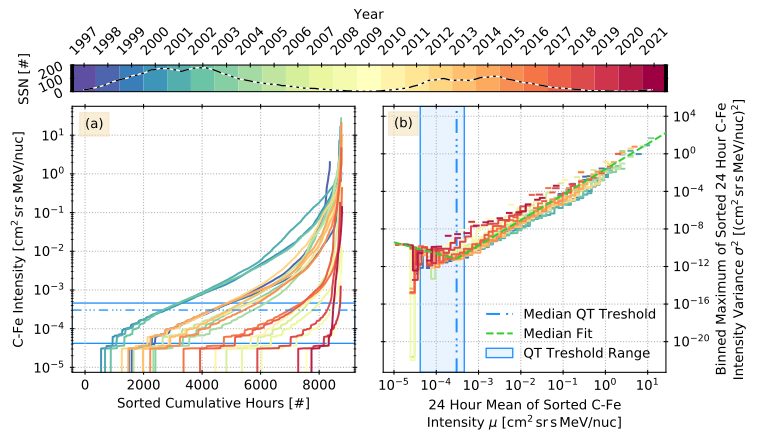
Quiet-time thresholds remain consistent across two solar cycles
Despite spanning two complete solar cycles with dramatically different activity levels, the quiet-time thresholds cluster within a narrow range.
Validates that the quiet-time selection method produces consistent thresholds across two full solar cycles, ensuring that downstream suprathermal abundance measurements reflect real physical changes rather than methodological drift
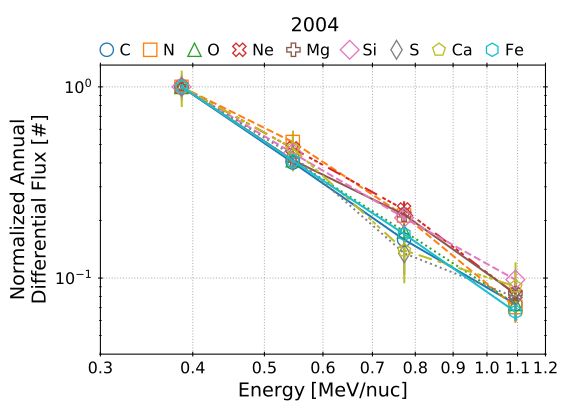
Nine heavy-ion species fall along identical power-law spectra
Despite spanning a factor of nearly five in atomic mass — from carbon (mass 12) to iron (mass 56) — every element produces essentially the same spectral shape during quiet times.
Shows all 9 elements following the same spectral slope
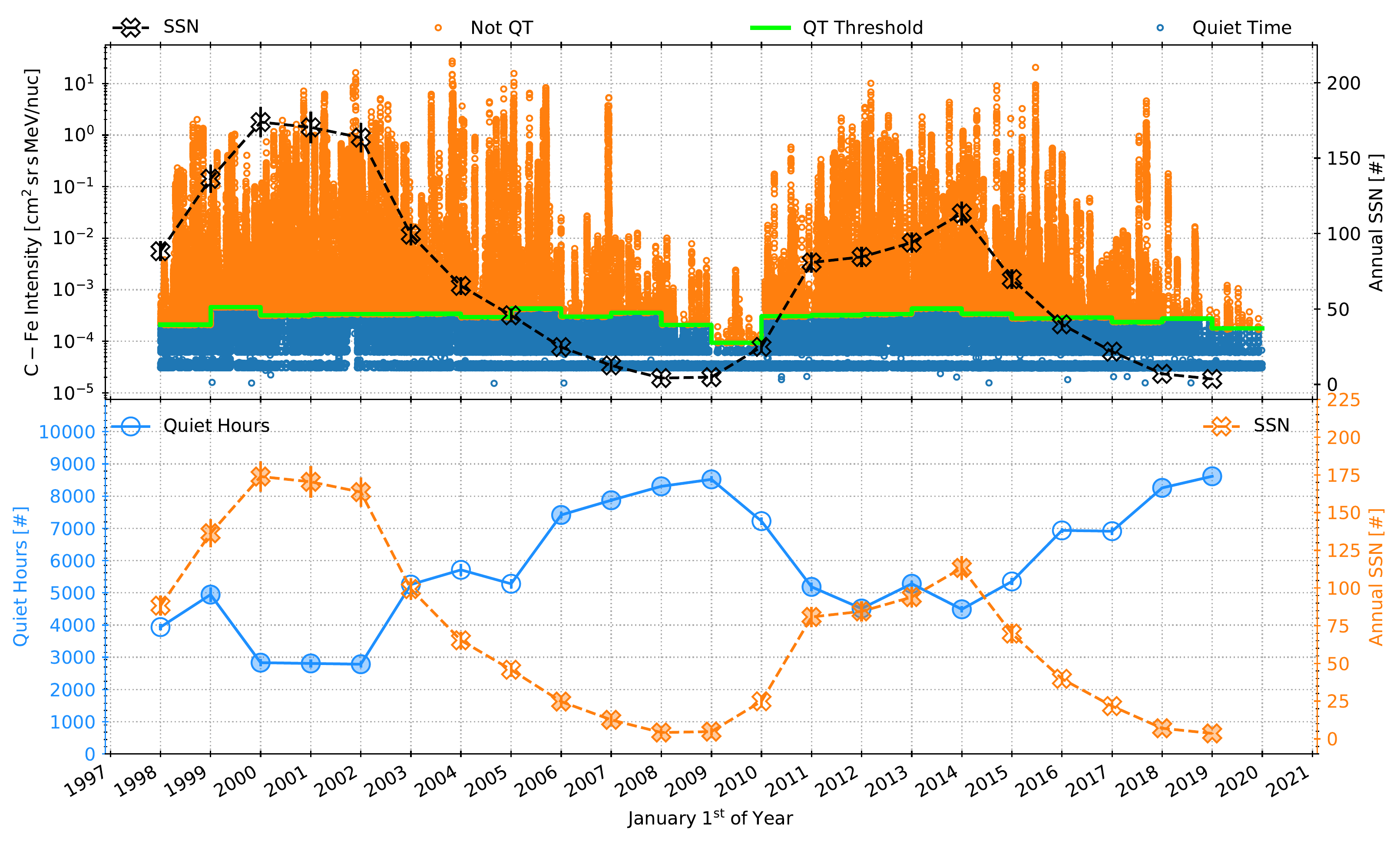
Quiet hours peak when sunspot activity drops to its lowest
The number of quiet hours strongly anticorrelates with sunspot number at a Pearson correlation of -0.95.
Confirms that quiet hours anticorrelate with sunspot number at -0.95, validating the quiet-time identification as physically meaningful and establishing the 22-year baseline for studying suprathermal composition evolution
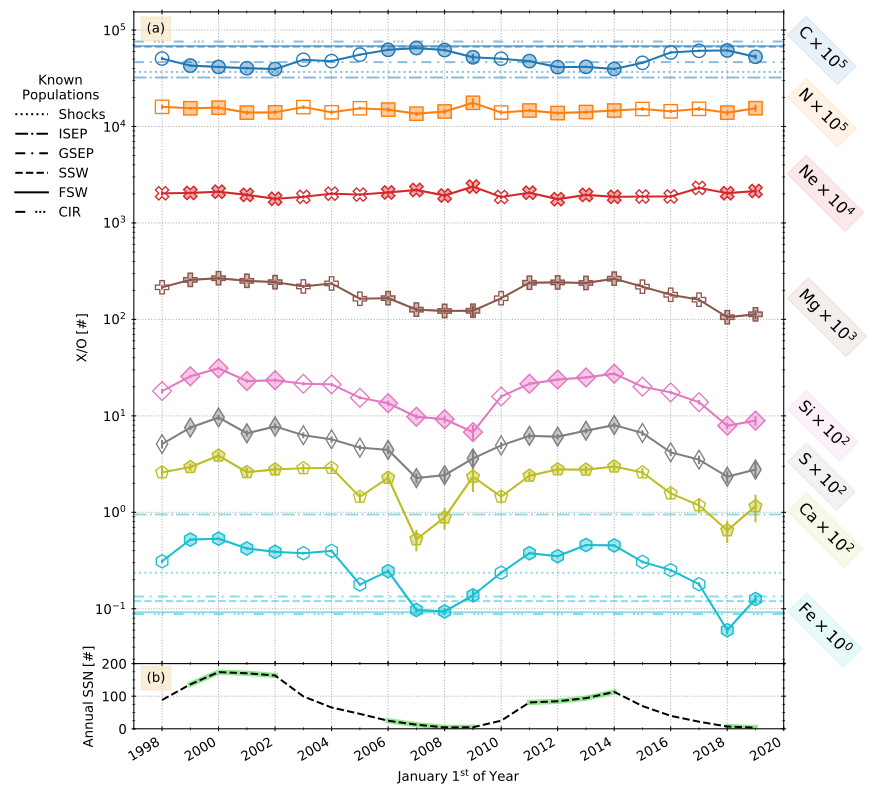
Heavy ion abundances shift between CIR and SEP values with the solar cycle
Heavy element abundances in quiet-time suprathermal ions change systematically with the solar cycle.
Proves suprathermals are remnants from CIRs during solar minimum and CME-driven shocks during solar maximum
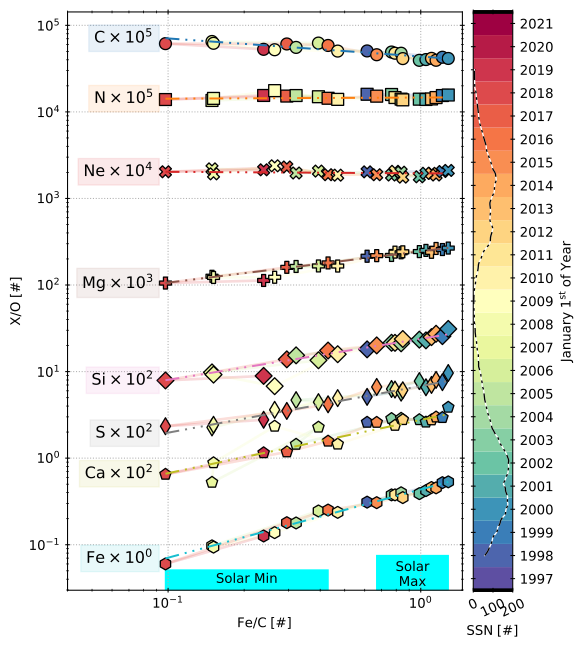
All heavy ion abundances follow power-law trends with Fe/C ratio
Fe/C serves as a sensitive single-number indicator of the overall heavy-ion enrichment state in quiet-time suprathermals.
Reduces the complex behavior of eight suprathermal elements to power-law relationships with a single enrichment indicator (Fe/C), revealing cyclic composition loops tied to solar activity phase
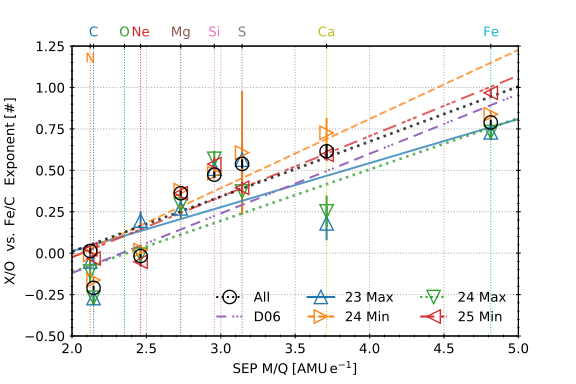
Suprathermal variability increases with mass-per-charge, matching GSEP trends
The variability of quiet-time suprathermal abundances increases systematically with mass-per-charge ratio across all solar cycle phases.
Connects suprathermals to their role as seed population for solar energetic particle events
See Also
Source
Quiet-time Spectra of Suprathermal Heavy Ions near 1 au in Solar Cycles 23 and 24
The Astrophysical Journal Letters (2024)
View Paper© 2024 The Author(s). Published by the American Astronomical Society. CC BY 4.0